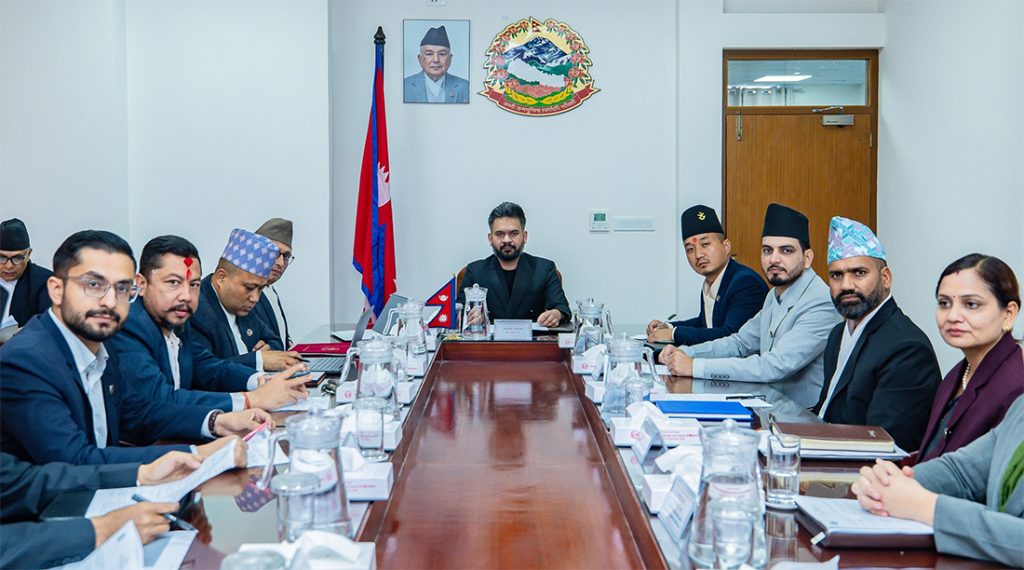
Elderly allowance remains unchanged!
The Elderly Social Security Fund in Nepal, commonly known as the Old Age Allowance (OAA), was first introduced in 1994 with the aim of providing financial assistance to senior citizens as per status of National Planning Commission, 2012. The token of support to elderly people has seen changes in times since its inception. This time, […]

The Elderly Social Security Fund in Nepal, commonly known as the Old Age Allowance (OAA), was first introduced in 1994 with the aim of providing financial assistance to senior citizens as per status of National Planning Commission, 2012. The token of support to elderly people has seen changes in times since its inception. This time, people were saying and hearing that the age bar of the senior citizen might be shifted to 75 years. This has made elderly people worried if the allowance system went through a drastic change. However, the Government had indicated that that was a rumour, the financial support to the elderly people will remain unchanged.
This is to be noted that the amount the Government provides them as OAA is not significant for some, but for many, it’s a ‘lifeline’ in terms of social and moral support.
In Nepal, only Government employees are entitled to receive retirement benefits. The volume of such people are not large in comparison to the people above 70.
That could have been addressed if contribution based retirement plan were systematized many years back so as people not in government jobs at retirement age now could get financial benefits as annuity or something else.
Some insurance agencies had floated symbolic ‘annuity’ schemes, but people who need it could not catch. For this to be truly made effective, the contributors who later turn into beneficiaries should understand the scheme. They need to participate in the debates and discourses or ‘well communicated to be convinced to manage to contribute. Moreover, the state should be serious to make it mandatory including plans to support poor people to contribute and participate.
This also to be noted that Government support for medical treatment to the poor people in heart, kidney, cancer also have been discontinued. However, a new insurance scheme has been introduced. The target beneficiaries still are unaware of the scheme and benefits from it.
The National Population and Housing Census (2011) highlights a demographic shift towards an aging population, underscoring the necessity for robust social security systems. The Senior Citizens Act of 2006 establishes a legal framework for the protection and welfare of elderly citizens, ensuring their rights and outlining provisions for social security benefits. The Universal Declaration of Human Rights (UDHR), particularly Article 25, affirms that everyone is entitled to a standard of living adequate for health and well-being, including necessary social services and security in old age. Additionally, the WHO Global Strategy and Action Plan on Ageing and Health (2016- 2020) emphasizes priorities for healthy aging, advocating for sustainable systems that provide long-term care and improve monitoring and research on healthy aging. In Nepal, the elderly security fund is a critical component of the social protection system, offering essential support to older citizens. Despite significant advancements in policy formulation and implementation, challenges persist regarding benefit adequacy, administrative efficiency, and coverage gaps.
While the Social Security Fund (SSF) plays a vital role in supporting Nepal’s elderly population, the findings of this study indicate that current benefits are inadequate for ensuring a comfortable retirement. The increasing number of beneficiaries – now exceeding 3.8 million – combined with rising living costs and healthcare expenses, underscores the urgency for reform in the social security system. The study reveals significant disparities in awareness and utilization of the SSF among elderly individuals, with many lacking sufficient knowledge about their entitlements. This gap is particularly pronounced among those with lower educational levels and those residing in rural areas, where access to information is limited. To address these challenges, targeted awareness campaigns are essential. These initiatives should aim to educate elderly citizens about their rights and the benefits available to them, ensuring that all individuals can effectively navigate the social security landscape. Moreover, the adequacy of payments from the SSF is a pressing concern. With many elderly individuals relying solely on these funds for their livelihood, it is critical to reevaluate the payment structures.
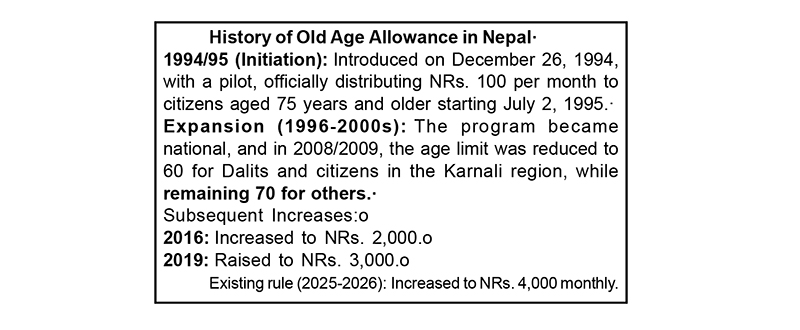
Currently set at NPR 4,000 per month, this amount often falls short of covering basic living expenses, particularly healthcare costs. Policymakers must consider adjusting these payments to reflect inflation and rising costs of living, thereby enhancing the financial stability of retirees.
The Department of National ID and Civil Registration lists that in FY 2080/81, a total of 38,29,485 people received various social security schemes. This number represents 13.13% of Nepal’s 29.16 million people. Of this, Senior Citizens (age 68 and above) recipients were 16,89,196 in total (44.1%), Senior Citizens (Dalits) were 1,56,161 (4.1%), Senior Citizens (Single Women) 181,863 (4.7%), Senior Citizens (Targeted Districts) were 16,480 (0.4%). Thus, those receiving senior citizens allowance in total were 20,43,700 or 53.3% of total social security allowance recipients. In total, 7% of Nepal’s population receive Senior Citizens allowance.
The government spent a total of Rs. 1,08,81,44,82,000 in FY 2080/81 for social security allowance distribution.1 Of this, those receiving old age allowance amounted to Rs. 57,99,81,18,906. There have been calls to critically look at the growing strain of social security allowance on the government’s finances. Along with this, the population demographics of Nepal also favour privileged and urban citizens in terms of receiving social security schemes, which has led to calls for a thorough assessment of this policy to guarantee effectiveness and fairness.
Senior citizens in Nepal were historically seen as their families’ responsibilities, so formal government attention to their well-being only became extensive with the Senior Citizens Policy in 2002 and the Senior Citizens Act in 2006. During the Ninth Plan (1997-2002) and the Three-Year Interim Plan (2007/08-2009/10), efforts were made to assist senior citizens through the creation of old age homes, day care centers, and offering concessions in public services and healthcare. The Old Age Allowance was implemented in 1994, giving NPR 100 to individuals aged 75 and above. This allowance has seen incremental increases and expansions, now providing NPR 4000 per month to those aged 68 and above, Rs. 2660 for Senior Citizens above 60 years who are Dalits, as well as for single women above 60 years.