Biska Jatra, the festival observed lavishly in Bhaktapur and Thimi
BiskaJatra is one of Bhaktapur’s most popular festivals. The festival carries rich cultural significances and social values. The Jatra, which takes place mid-April is the largest Jatra celebrated in Bhaktapur. It is celebrated for eight nights and nine days. This Jatra is also known as BisketJatra in an easier glossary while it is also called […]
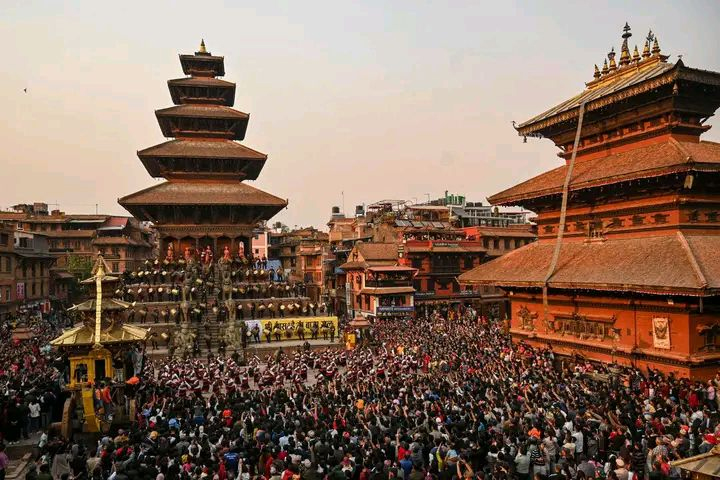
BiskaJatra is one of Bhaktapur’s most popular festivals. The festival carries rich cultural significances and social values.
The Jatra, which takes place mid-April is the largest Jatra celebrated in Bhaktapur. It is celebrated for eight nights and nine days. This Jatra is also known as BisketJatra in an easier glossary while it is also called but rarely as Vishwodhojotthan Jatra denoting to the sacred wooden pole that represent God Vishwanath.
The craze of people for this festival is just indescribable. Just to attend this festival, thousands of people from different parts of the country gather in Bhaktapur. The festive ambience gives feeling like the whole city is desolate and all people are in the streets of Bhaktapur.
The main attraction of this Jatra is the Yosindyo (the God in the sacred wooden pole). That is also pronounced as lingo. It is a sky-high unbending pole that locals erect on the last day of the month, Chaitra. And then lie down in the next eve. People gather and participate in erecting and lying of the Yosin with all the festive mood.
the process of lying the lingo down is well known as the SatruhantaJ atra which means seeing the downfall of your enemy. There is a common belief that whoever sees the lingo lying down to the earth, their enemy also meets the fall.
This event falls on the very first day of the new year of Bikram Sambat (BS). That means Nepali new year, where the fact is that this Biskajatra has no relation with the Nepalese new year.
Admittedly, the Malla kings had heightened the importance of Biska Jatra by adding a chariot festival to this event. People assemble and collide with the chariot of Bhairava and Bhadrakali against each other during the festival.
The tug of warlike festive sensation that ensues as people pull the unequal number of ropes is thus biased toward the forward direction.
A tug of war begins to determine to which half of the city the chariot will go first. It is considered that the presence of the chariot represents a Darsana, a manifestation or “showing himself” of the deity Bhairava to that city half. The men from the lower half of the city try to pull the chariot out of Taumadhi Square into and along the Bazaar street to the south and then west as far as the Tekhacho twa.
The people from the upper city try to pull it out of the square along Bazaar street to the north and east into their half of the city as far as Dattatraya Square. Moreover, the tug of war is the most dangerous part of this event which made out this festival one of the most dangerous festivals in the world.
As per the locals, this practice will bring good luck to the city. It is believed that with this act being done, there will be the blessing of god bestowed upon them. As a result, there will be no drought or excessive rain, no shortage of food, and any kind of illness.
There are some legends about the Biska festival. Some anecdote states that King Jagat Jyot iMalla first started this Jatra. It is said that he was so impressed by the story of serpents that it inspired him to recreate it as a Jatra.
As per the story, there was a cursed princess who became a widow right after the next day of her marriage. It was a mysterious series of death. Whoever married her used to be found dead the next early but no one knew how he died. In this setting, there came a situation where no one dared to marry her.
But, one day, a prince with Tantric power came and get a knot with the princess. He married her despite knowing about the curse. He was a brave person and wanted to solve the mystery of mysterious deaths.
For that reason, he stands awake the whole night. And consequently, he found something very suspicious about the princess. The two serpents steadily came out from her nostrils. Meanwhile, the prince sprightly cut them down into pieces with his swords as soon as he saw them crawling.
Those two serpents were the reasons for all those mysterious deaths. And this is how the curse was cured. Therefore, to celebrate this victory against those serpents, people start to celebrate Biska Jatra.
This is more like a folklore that is just to tell and listen. However, the actual reason for celebrating Biska Jatra might be more than just a story related to serpents.
Besides this, people also celebrate the Jatra of Mahalaxmi, Mahakali, Bramayani, and Maheshwari during the festival.
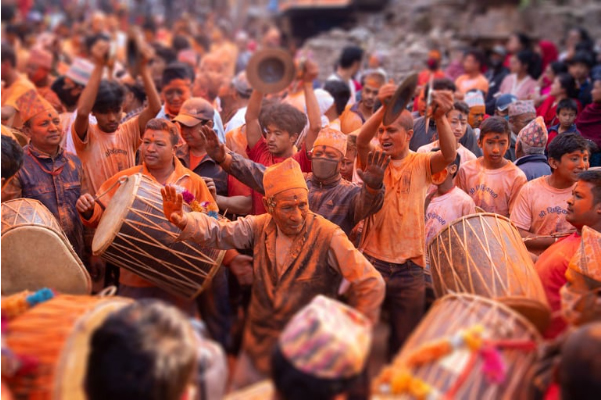
During the festival, in Madhyapur Thimi, devotees gather and take out a procession carrying 32 chariots containing the idols of several gods and goddesses. People smear each other with Sindoor (orange vermillion powder) as in the Holi festival and sing and dance to the tune of traditional music during the procession.
Each year, on the second day of the Nepalese New Year, Bode witnesses a tongue-piercing ceremony. One resident spends the whole day with an iron spike piercing his tongue and roams the city carrying multiple fiery torches called Mahadip on his shoulder.
Biska Jatra celebrated in Thimi has its own flavour, unlike the Biska Jatra in other places in Bhaktapur. Thimi is an ancient town settled by Newar people. It is located at the center of three major cities of Kathmandu valley: Bhaktapur, Lalitpur, and Kathmandu. Therefore, this city is also named Madhyapur. It denotes Mid-city in the Nepali language.
It lies about ten kilometers east of Katmandu and some 3km from Tribhuvan International Airport. This city is on the way toward Bhaktapur from Kathmandu. This ancient city is rich in cultural and traditional values. It is one of the few townships where one can experience the genuine Newari culture, in terms of both festivals and lifestyle.
Bisket Jatra of Thimi is also called Sindur Jatra (Vermilion Powder Festival) as people’s faces are covered with orange color. In Thimi, it is celebrated for three days.
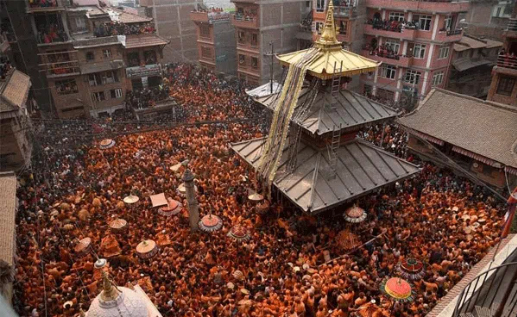
On Nepali New Year’s eve, the Jatra (festival) takes place in the Vishnuvir Temple area nearby Balkumari. On the evening of the first day of the year, it takes place in the Siddhikali temple area. On the second day of New Year which is also the special and main day of Bisket Jatra of Thimi, it takes place early in the morning at the Balkumari Temple area. Balkumari is the most revered temple in Thimi.
On the main day (3rd day of the festival) early in the morning people from the various parts of Thimi bring chariots (Khats) carrying images of different Gods to the premises of Balkumari Temple. These khats are carried on their shoulders and parade up and down the streets with Sindur (orange powder) hurled at them.
The people throw Sindur at each other and dance to the beats of drums, cymbals, and Dhimes (traditional musical instruments). The crowd parades the town with khats, sindur, musical instruments, and dances. They revolve around the Balkumari temple with chariots.
Folks from various parts of Madhyapur Thimi carrying 32 chariots of deities gathered and revolved around Baalkumari temple. People carry flaming torches or play drums and cymbals. The vermilion powder is spread around each other bodies with joy playing Newari Dhime music. In no time the whole locality turns colourful orange. The environment becomes unbelievably too festive with time.