World Water Day 2026 to celebrate emphasizing on importance of water and gender
World Water Day, held on 22 March every year since 1993, is an annual United Nations Observance focusing on the importance of fresh water. World Water Day celebrates water and raises awareness of the 2.1 billion people living without access to safe water. It is about taking action to tackle the global water crisis. […]

World Water Day, held on 22 March every year since 1993, is an annual United Nations Observance focusing on the importance of fresh water.
World Water Day celebrates water and raises awareness of the 2.1 billion people living without access to safe water. It is about taking action to tackle the global water crisis. A core focus of World Water Day is to support the achievement of Sustainable Development Goal 6: water and sanitation for all by 2030.
Every year, UN-Water – the UN’s coordination mechanism on water and sanitation – sets the theme for World Water Day. In 2024, the focus was on Leveraging Water for Peace; in 2025, on Glacier Preservation. In 2026, the theme is Water and Gender.
In the lead-up to 22 March, people and organizations host World Water Day events and promote the theme through communications, advocacy and social media.
The UN World Water Development Report is released, focusing on the same topic as the campaign and recommending policy direction to decision makers.
Theme for the World Water Day this is Water and Gender. The reason behind theme for this explains as women and girls are disproportionately affected by water-related challenges due to entrenched gender roles, inadequate infrastructure, underrepresentation, limited funding, restrictive social norms and systemic inequalities.
World Water Day 2026 is all about how water and gender equality are deeply interconnected.
Without safe water, sanitation and hygiene close to home, women and girls bear a heavier burden than men and boys. They collect and manage water. They care for people made sick by unsafe water. They lose time, health, safety, and opportunities. And, they are often left out of decision-making.
This makes the global water crisis a women’s crisis. It’s time to centre women and girls in water solutions – not only as users, but as leaders, engineers, farmers, scientists, caregivers and changemakers.
Because when women and girls are empowered to play their full role alongside men and boys, everyone thrives. That’s why this year’s campaign is called ‘Where water flows, equality grows’.
The 2026 World Water Day campaign calls for a transformative, rights-based approach where women have equal voice, leadership, and opportunities in water decision-making – making water a force for a healthier, more prosperous, gender-equal future that will benefit us all.
Access to safe water is a human right, yet 2.1 billion people still live without safely managed drinking water services, with devastating impacts for their lives and wider society.
A well-managed water cycle underpins the 2030 Agenda for Sustainable Development and is essential for action on climate change.
The UN System-wide Strategy for Water and Sanitation is a commitment by the UN and our partners to unify and maximize support – technical and financial – to help countries make faster and greater progress. The Strategy’s Collaborative Implementation Plan sets out how UN entities and partners will work together to achieve more rapid and impactful results.
To mark World Water Day 2026, UNU-IAS will co-organize an online seminar exploring ways to mainstream gender in water and sanitation issues. Celebrated annually on 22 March, World Water Day is a UN Day of Observance with a core focus on supporting the achievement of SDG 6 (water and sanitation for all), raising awareness of the 2.1 billion people living without access to safe water.
The theme for 2026 is Water and Gender. The global water crisis affects everyone, but not equally. Where people lack the rights to safe drinking water and sanitation, inequalities flourish, with women and girls bearing the brunt. Too often, the systems that govern water leave women and girls out of decision-making, leadership, funding and representation. This webinar will discuss transformative, rights-based approaches to solving these challenges, where women’s voices are heard and their agency recognized.
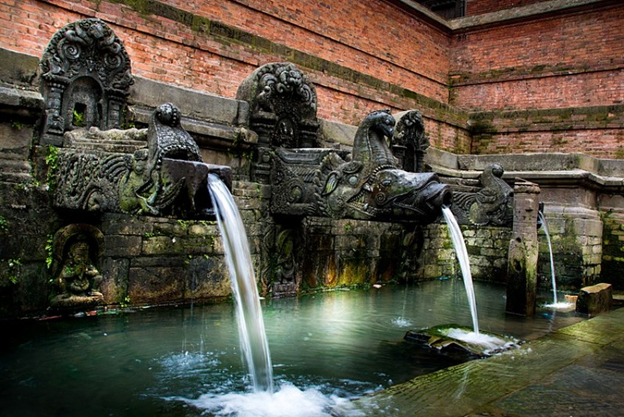
Traditional water spots in Nepal
It has been realized that clean water, basic toilets and good hygiene practices are essential for the survival and development of children. Without these basic needs, the lives of millions of children are at risk. For children under five, water- and sanitation-related diseases are one of the leading causes of death. Every day, children die from preventable diseases caused by poor water, and a lack of sanitation and hygiene.
So as Nepal has made significant progresses in expanding access to water and sanitation over the last few decades despite tremendous challenges such as poverty, difficult terrains and conflicts. Compared to 46 per cent in 1990, ninety-five per cent of households now have access to improved water sources and sixty-two per cent of households are using an improved sanitation facility, up from 6 per cent in 1990.
Functional status of water schemes and the quality of water remains poor with 71 per cent of all water sources and 91 per cent of those used by the poorest quintile contaminated with Escherichia coli bacteria.
Only 25 per cent of the water supply is reported to be fully functioning and almost 40 per cent requires major repairs.
Open defecation is still practiced by 16 per cent of the population (NDHS).
Twenty per cent of government schools lack improved water and sanitation facilities, with an additional 19 per cent lacking separate toilets for girls and boys and menstrual hygiene management facilities.
In the country programme (2018-2022), UNICEF’s WASH component is guided by the WASH Sector Development Plan (2016–2030), to be implemented by the Ministry of Water Supply. Our water, sanitation and hygiene (WASH) section works in Nepal to improve water and sanitation services, as well as basic hygiene practices.
Advocacies voice on need of strong activities on WASH improvement saying strategies to enhance access to safe water in schools and health care facilities include fostering inter-sectoral collaboration, scaling up sanitation movements, and engaging the private sector for hygiene promotion. Key actions involve advocating for gender and disability-friendly sanitation, utilizing mass media for hygiene awareness, improving water quality through regulatory enhancements, and ensuring access for marginalized populations. Support for formulating a new WASH act, revising policies for gender equality, and integrating Disaster Risk Reduction and Climate Change Action into WASH policies is also essential.