Nepal readying for 30,000 MW electricity generation in 10 years
The Government of Nepal has set a target of generate 30,000 megawatts of electricity within the next 10 years. This has been mentioned in the draft of the national commitment prepared by the Government incorporating important components of manifesto of six major political parties prior to the March 5 elections. The Government made the draft […]
The Government of Nepal has set a target of generate 30,000 megawatts of electricity within the next 10 years. This has been mentioned in the draft of the national commitment prepared by the Government incorporating important components of manifesto of six major political parties prior to the March 5 elections.
The Government made the draft public recently in mid-April. The previous government had set a target of 28,500 megawatts to generate over the next decade, while the new target increases this by around 1,500 megawatts. So far, the country has installed various electricity generating plants with installed capacity of about 4,000 megawatts.
Currently, there are various electricity generating proposals at different stages to generate around 12,000 megawatts awaiting Power Purchase Agreements (PPA). Likewise, approximately various projects to generate around 3,000 megawatts are under construction. India, the neighbour at South alone is developing about 5,000 megawatts of hydropower projects. Moreover, the country has already signed an agreement with the Government of Nepal to purchase 10,000 megawatts of electricity from Nepal within 10 years.
Energy and Energy Commission Nepal mentions that has the economic and technical potential to generate around 72,000 megawatts of electricity under Q40 conditions (Q40 denotes for the design discharge based on the volume of water flowing in a river available for 40% of the time in a year). However, if electricity is generated under Q25 provision, the country could be able to generate produce up to 120,000 megawatts, according to the commission. This is important to note that full flow of water in the rivers in possible in the wet seasons only).
For achieving the 30,000-megawatt target within the next 10 years, the Government plans to amend laws related to land, forests, and the environment, along with implementing policy reforms which have been considered to as obstacle for rapid hydropower development. It is stated that priority will be given to reservoir-based and Peaking Run-of-River (PRoR)projects, with project development supported through viability gap funding (VGF).
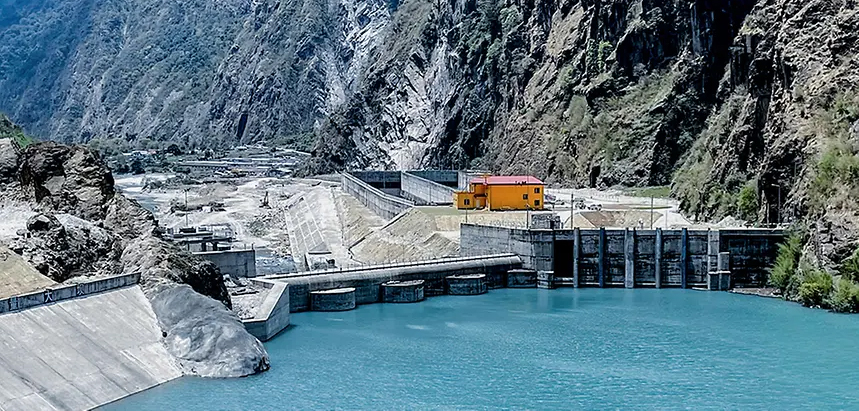
Large projects such as the Budhigandaki Hydropower Project and DudhKoshi Hydropower Project will be developed using VGF. For the 1,200-megawatt Budhigandaki project, the Government has already established a dedicated company and its investment framework approved. Environmental studies, detailed design, and other required assessments have been completed, and about 96% of compensation distribution has already been finalized.
The Government also plans to attract large industries which consume large amount of electricity, such as steel, cement, herbal processing, data server stations, and chemical fertilizer industries. Moreover, private sector participation will be encouraged in storage type hydropower projects, energy storage systems, transmission, and distribution systems through investor-friendly policies and legal frameworks. The government has also stated that it will expand transmission lines to industries to increase domestic electricity consumption.
Through energy diplomacy, the Government aims to strengthen bilateral and regional cooperation and expand energy trade with neighbouring countries, including India and Bangladesh. So far, Nepal has been engaged in electricity trade (import and export) with India for long time, and since 2024. It has started exporting around 40 megawatts of electricity as a good gesture to Bangladesh as well.
To develop Nepal as a clean energy export hub in South Asia, the Government plans to increase investment in clean energy generation, transmission, and distribution systems. It also aims to prioritize green hydrogen production and the exploration of strategic minerals such as rare earth elements. The commitment further states that Nepal will be developed as an energy-friendly nation through the promotion and export of green energy.