Risk and remedies of GLOFs in Nepal needs to be taken seriously
Glaciers are nature’s frozen sentinels, vast rivers of ice and snow that carve the Earth, silently bearing witness to the passage of time and the shifting rhythms of our planet. They are essential to Earth’s ecosystem, acting as critical freshwater reservoirs and indicators of the planet’s health. They provide water for millions of people, regulate sea […]

Glaciers are nature’s frozen sentinels, vast rivers of ice and snow that carve the Earth, silently bearing witness to the passage of time and the shifting rhythms of our planet.
They are essential to Earth’s ecosystem, acting as critical freshwater reservoirs and indicators of the planet’s health. They provide water for millions of people, regulate sea levels, and support biodiversity.
Yet, these frozen giants are under threat. Rising global temperatures are causing glaciers to retreat at an alarming rate, leading to water scarcity, rising sea levels, and increasing the chances of natural disasters like floods or landslides.
These cascading changes jeopardize ecosystems, human livelihoods, and economies around the world. To address this urgent challenge, ambitious action to reduce greenhouse gas emissions is essential.
World Day for Glaciers along with the Decade of Action for Cryospheric Sciences (2025-2034), encourage us all to act to preserve the vital role of glaciers in sustaining life on Earth for generations to come.
21st March 2025 was the date that first ever International Day of Glacier was celebrated world-wide.
The aim of celebration is to raise awareness and actions on shrinking glaciers. As it is noted that glaciers are getting smaller each year; they are melting and losing more ice than they are gaining from snowfall or other solid precipitation.
The loss of glaciers is a loss for society. Glaciers are beautiful in their own right, forming some of our world’s most inspiring landscapes. They have a cultural importance, being revered by mountain and polar communities in different regions across the world. They have an economic importance and value; glaciers bring in funds through tourism and adventure travel. But most importantly, glaciers provide ecosystem services. As they melt, they maintain the river flow down-valley, especially in dry seasons and even more importantly in drought years. This melt eventually makes its way to the sea, where it contributes to global sea level rise.
Worldwide, glaciers separate from the large Antarctic and Greenland ice sheets now lose a total of 266 billion tonnes of ice every year, driving 21% of currently observed sea level rise.
Globally, the rising sea levels would mean that the current 1-in-100 year flood events could occur at least annually in half of tide gauges worldwide. With global coastal populations exceeding 600 million people, many millions of people would be displaced by 2050 CE, leading to increased migration driven by climate change.
In mountain regions of the world, communities rely on glacier meltwater. Glacierised basins worldwide cover 26% of the global land surface, and many are densely populated. The mountain ‘water towers’ of the world provide water resources to up to 1.9 billion people worldwide as a result.
This water is used extensively for irrigation, hydropower, industry, and domestic consumption. Mountains are also biodiversity hotspots, with meltwater supporting a range of important and diverse habitats. As the glaciers shrink, water shortages are exacerbated, especially during drought years.
With many millions of people affected, this would increase climate change migration and refugees across numerous international borders.
The most effective way to preserve glaciers is by reducing carbon dioxide emissions and curbing the rise in global heating. While we can hypothesise about potential glacier-geoengineering solutions, none of these are tested and may cause more harm than good. All would require substantial investment in inhospitable and often politically contested parts of the world; funds that would be better invested in clean energy and transport.
Nepal has a strikingly diverse topography. Within just 150–200 km across the width of the nation, its elevation shifts dramatically from the low-lying Terai Plains (~70 m asl) to Mount Everest (8,848 m), the world’s highest peak.
This extreme altitudinal variation creates multiple climatic zones across its relatively small area (147,516 km²), supporting ecosystems ranging from subtropical forests in the south to alpine meadows and glacial landscapes in the north. Nepal’s glaciers form the headwaters of Ganges River, a lifeline for 400 million people2 in the basin.
Climate change is accelerating glacial recession and ice mass loss in the Nepal’s Himalaya, exposing its mountain communities to cascading impacts, including water shortages and increased hazards such as glacial lake outburst floods (GLOFs), avalanches, and rockfalls3. These impacts extend further downstream, exacerbating flood hazards, water insecurity, and economic instability3,4. Glacier recession in Nepal is driven by temperature rises and influenced by ice dynamics e.g. debris cover, lakes and topography.
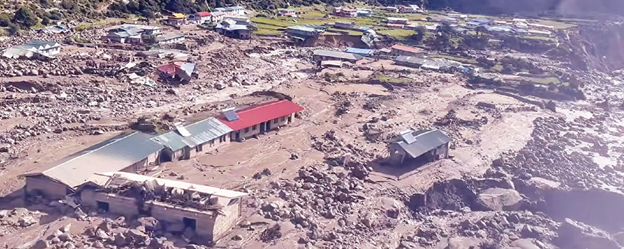
Flood in Khumbu region due to outburst from Thyanbo glacial lake (2024 August)
Glacial retreat, thinning, and mass loss since the 1970s have caused the rapid expansion of glacial lakes in the Nepal Himalaya. Between 1977 and 2017, the number of glacial lakes grew from 606 to 1,541, with a 25% increase (from 64 km2 to 85 km2) in lake area.
Of the 1233 lakes mapped across Nepal’s Koshi, Gandaki, and Karnali River basins, 21 are classified as potentially dangerous due to their high risk of GLOFs.
GLOFs have become a defining cryospheric hazard in Nepal, yet their risks remain poorly quantified. 26 GLOF events causing significant damage to downstream communities have been recorded so far18. However, many GLOFs remain unreported due to their smaller scale, low impacts or occurrence in uninhabited areas.
Major GLOF events in Nepal include the 1985 Dig Tsho outburst, which destroyed bridges, agricultural lands, and a hydropower plant, and the 2016 Bhotekoshi/Sunkoshi event, which damaged infrastructure and disrupted the Araniko Highway for several days18,19. Recent events, such as the 2021 Melamchi and 2024 Thame GLOFs, were triggered and intensified by extreme rainfall at the beginning and end of the monsoon.
Tso Rolpa and Thulagi are among Nepal’s most closely monitored glacial lakes. Despite being partially drained and lowered by three meters in the early 2000s, Tsho Rolpa continues to expand rapidly, now covering 1.6 km², roughly the size of 148 football field and keeping the threat of an outburst alive19,21. Similarly, Imja Lake, once highly hazardous, had also its water level lowered by three meters in 2016 through controlled drainage, and is now thought to be at lower risk of outburst.