Kathmandu celebrates Pahan Charhe and Ghoda Jatra
Pahan Charhe is a festival celebrated by the Newars of central Kathmandu city. The festival falls on the fourteenth day of the lunar fortnight and the day after. The festival sees the invitation of beloved guests and members of the family to take part in a magnificent feast prepared for the occasion. Statues of gods […]

Pahan Charhe is a festival celebrated by the Newars of central Kathmandu city. The festival falls on the fourteenth day of the lunar fortnight and the day after. The festival sees the invitation of beloved guests and members of the family to take part in a magnificent feast prepared for the occasion.
Statues of gods and goddesses like Ganesh and Ajimas (AshtaMatrika) with different names are carried in temple shaped palanquins by devotees are taken round to Hanumandhoka durbar area, Tundikhel and Asan mainly. The festival is celebrated for three days. the first day sees the worship of the deity of Luku Mahadyah (Lord Shiva in hiding). Luku in Newari means hidden whereas Mahadyah is a local name for Lord Shiva. This day sees members of the household clean their homes and surroundings and make offerings to the deity. At Ngyeta (Naradevi) a special mask dance of the Ngyetamaru Ajima (Swetakali) is performed. The sacred dance features performers dressed in the traditional colours of the Ajima’s with a mask perform tales of Swetakali. The dance is in an archaic form of storytelling, which starts in the evening and continues through the night.
The Ajima’s are protective goddesses placed by the Malla Kings in early period of their regime at strategic locations around the city to forming a protective ring.
The protective goddesses are symbolized as the shakti (strength) of Male Gods. The eight mother goddesses are Brahmayani (The Shakti of Lord Brahma), Maheswari (The Shakti of Lord Shiva), Bal Kumari (The Shakti of Lord Bhairav), Vaishnavi (The Shakti of Lord Vishnu), Barahi (The Shakti of Lord Narayan), Indrayani (The Shakti of Lord Indra) whereas Chamunda and Mahalaxmi are fierce manifestations of Goddess Kali and Laxmi.
On the second day, which is also known as Dyoh Lwakegu is celebrated at the open field of Tudikhel. During when shrines of the Ajima are placed in a palanquin and paraded in their respective locals in Kathmandu.
The day also sees the celebration of the annual Ghode Jatra, one of the most important festivals of the Newars. The legends of the Gurumapa are stories with which Newar children grow up with and is folklore in the valley.
During the night, the gods and goddesses in palanquin is taken to Tudikhhel which is followed by an entourage of devotees and traditional Newari musical ensemble. Each community brings forth a flame torch which is exchanged symbolizing the meeting of the goddesses.
The third and final day of the festival sees the gathering of huge masses at the old city centre of Asan. The palanquins of Lunmari Ajima (Maheshwari), Kanga Ajima (Chamunda) and Tebhaa Ajima (Varahi) are brought there in respective palanquins and paraded in the street. These Ajimas are considered to be sisters. The historic market place sees the meeting of the individuals of the respective locales-who all wear coloured hats of red, blue and yellow which are respective of the localities.
During the Dyoh Lwakegu ceremony, participants accompanying the shrines exchange flaming torches. Devotees offer Chatanmari (traditional rice bread) to the deities and during this day can be seen thrown from the rooftops of in Asan. Traditional seasonal songs are placed the musical ensemble during the meeting of the gods, where participants can be celebrating with avid fanfare and dancing to the beautiful melody.
As a part of the Pahan charhe festival, Ghode Jatra, or the Horse Racing Festival, is celebrated with lively horse races and various cultural performances.
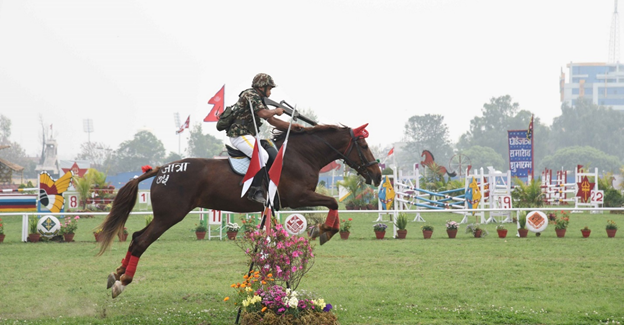
During Ghode Jatra, horse races occur on the historical Tundikhel grounds, accompanied by traditional music and dance. The elaborate horse parades, where decorated horses are shown off, are highlighted. Local people also perform rituals to drive away evil spirits, making it a colourful and significant occasion.
Ghode Jatra is believed to ward off evil spirits and is celebrated to mark the victory over a demon named Tundi. This demon once lived in a meadow – now known as Tundikhel – and constantly terrorized Kathmandu’s ancestors. To put an end to his reign of fear, he was trampled to death by horses and buried under a tree in the heart of Tundikhel. Since then, the festival has been observed annually, with a grand horse parade symbolizing the continued suppression of evil forces.
On the day, the Nepali Army cavalry team performs different artistic stunts riding on their horses. The Jatra is also being marked in Lalitpur in a different manner.