The investment board meeting held at Singhdurbar on Thursday under the chairmanship of Prime Minister KP Sharma Oli decided to increase the capacity of Paschim Seti by 50 MW. Thus, the capacity of West Seti Hydropower project will be 800 MW. Previously, the project was designed for 750 MW capacity.
The Investment Board Nepal (IBN) has approved significant investments in several hydropower projects, totalling over Rs 140 billion, during its 60th meeting held at Singha Durbar on Thursday.
The Indian company NHPC Limited, which won the Paschim Seti Hydropower project without competition, asked the Board of Investment to increase capacity and extend the survey permit. Accordingly, with the expansion of the capacity of Paschim Seti, the duration of the survey permit has been extended by one year. The company also wanted to change the coordinates of the West Seti project site, that was also approved, according the authority.
NHPC has already submitted the draft DPR of Paschim Seti while it is said that experts are studying the draft. According to the agreement, the draft of SR-6 should also be submitted within 6 months after the submission of the draft DPR of Paschim Seti. Although NAPC has submitted the draft DPR of SR-6, the board is in the process of giving it to experts for study.
The government broke the contract with the Chinese company China Three Gorges International Corporation (CTGI) after the project construction permit did not work for a long time. Later, during the investment conference 6 years ago, the government put the West Seti project in ‘Showcase’ to be connected with SR-6.
The Japan Cooperation Agency (JICA) conducted a preliminary feasibility study in 1993 of the proposed SR-6 project along Paschim Seti. Its detailed feasibility study has been done by the Electricity Development Department. While JICA’s study showed the possibility of generating electricity from SR-6 up to 670 MW, the department said that the maximum potential is only 300 MW.
Two years ago, in the presence of the then Prime Minister Sher Bahadur Deuba, an agreement was signed between the Investment Board and NHPC Limited to hand over the West Seti and SR 6 hydropower projects. After that, the survey permit was issued in October 2022. The agreement was to prepare the DPR and submit it to the Board of Investment office within two years of receiving the survey permission. Prior to that, the 51st meeting of the Board of Investment held on 23rd June 2019 decided to give the responsibility of preparing the development and investment blueprint for these two projects to the Indian company NHPCI Limited.
079 The 52nd meeting of the Board of Investment held on July 23 approved the memorandum of understanding for issuing survey licenses. The final DPR of the project will provide information on the overall social, economic, geological, technical and environmental aspects. Similarly, the DPR will guide the estimated cost of the project, the timing of the start and completion of the project and the action plan, market assurance, construction of transmission lines, availability of financial resources, etc. After analyzing the DPR, a Project Development Agreement (PDA) will be drawn up if the project is to be taken forward.
According to previous studies, the cost of the West Seti project with a capacity of 750 MW was estimated at 1,320 million US dollars and the cost of the SR-6 project with a production capacity of 450 MW was estimated at 800 million US dollars. In the memorandum of understanding between the Board of Investment, Nepal and NHPC Limited dated August 2, 2079, it is mentioned that 21.9 percent of electricity should be provided after commercial production starts.
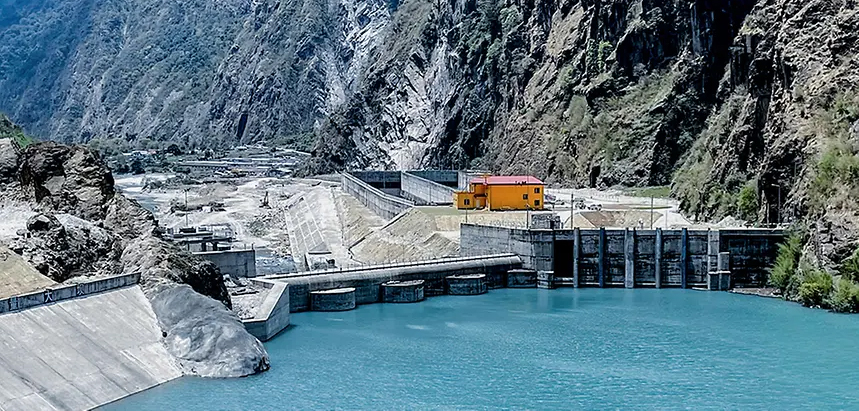
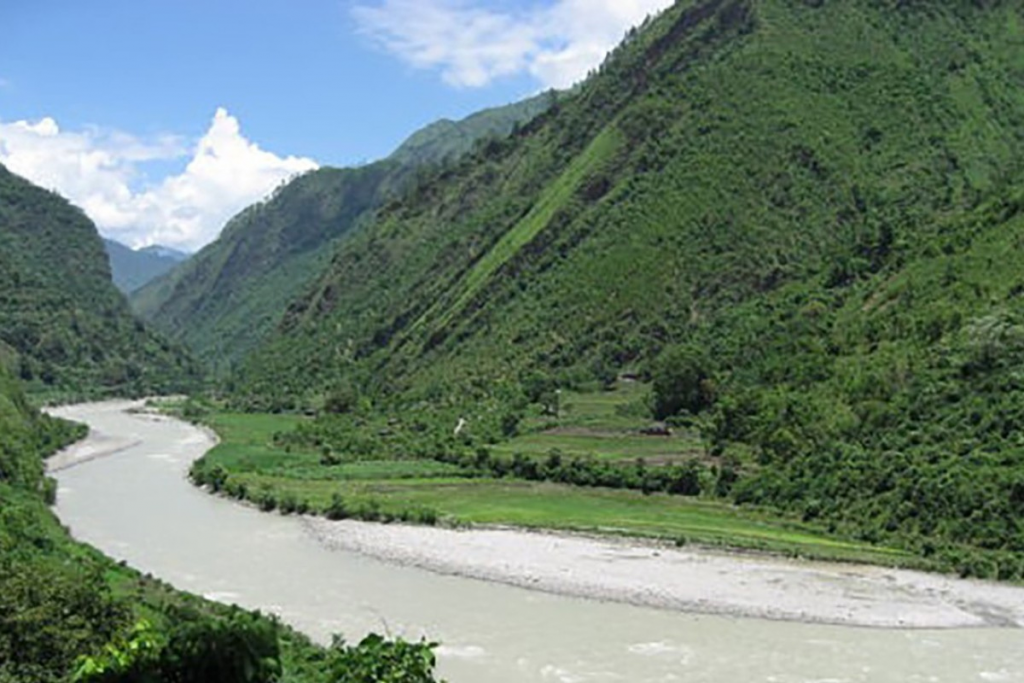
The West Seti Hydroelectric Project (WSHEP) is a 750 MW storage scheme proposed on the Seti River in the Far Western Development Region (FWDR) of Nepal by West Seti Hydro Limited (WSH), the project proponent. The dam site is located 67 km upstream of the confluence of the Seti River with the Karnali River.
The WSHEP will generate electrical energy (through an underground power station some 19 km downstream of the dam) throughout the year, storing excess wet season river flows in a reservoir and using this water to generate energy during daily peak electricity demand periods. The electricity will be exported to India under a Power Purchase Agreement (PPA), initialled in 2003 with Power Trade Corporation India Ltd (now called PTC India Ltd), and earn considerable export revenue for the project owner and the Government of Nepal (GoN). Power evacuation from the West Seti switchyard will occur via a 400 kV double circuit transmission line to the Atamanda substation in Uttar Pradesh (India), owned and operated by Power Grid Corporation India Ltd, with an estimated 3,636 GWh exported annually. Other project components include a headrace and tailrace tunnel; a re-regulation weir 6 km downstream of the tailrace outlet to regulate river flows and reduce rapid rises/falls in river levels created by power station releases; just over 20 km of permanent access roads; and temporary and permanent construction and operation facilities.