Nepal mountaineers worried ahead of spring climbing season amid fake rescue insurance fraud
Ahead of the spring climbing season for Mount Everest, Nepal’s mountaineering association has expressed serious concern in wake of the multi-million dollar insurance scam even as police on Friday denied news about mixing poisonous stuff with tourists’ food for prompting fake rescue. Nepal Police’s Central Investigation Bureau (CIB) that conducted a months-long investigation into the fake mountain […]
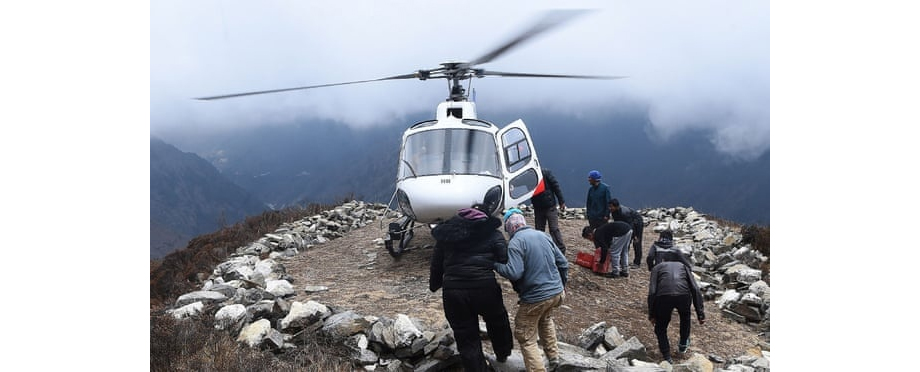
Ahead of the spring climbing season for Mount Everest, Nepal’s mountaineering association has expressed serious concern in wake of the multi-million dollar insurance scam even as police on Friday denied news about mixing poisonous stuff with tourists’ food for prompting fake rescue.
Nepal Police’s Central Investigation Bureau (CIB) that conducted a months-long investigation into the fake mountain rescue operations in the Himalayan region involving helicopter operators, trekking agencies and hospitals, has taken legal action against 32 individuals.
Out of 33 people against whom CIB took legal action, 32 people are freed after taking bail amounts, said CIB spokesperson Shiva Kumar Shrestha. The CIB had filed case at the Kathmandu District Court, which slapped fines on 32 individuals.
On Friday, the CIB, in a statement, refuted news reports about using poisonous food to the tourists in the name of conducting fake rescue, saying it as false and baseless.
“The serious attention of the CIB of Nepal Police has been drawn to the news reports in some national and international media about mixing poisonous stuff in the food for making foreign tourists ill to carry out fake rescue operations,” the statement said.

“When verified, the truth of such news could not be established. Thus making news by some national and international media as well as Facebook pages, on the basis of such false and baseless information is illegal as well,” the CIB said and requested all not to publish or spread such false news.
However, the magnanimity of the fraud hangs over the country ahead of the spring climbing season for Mount Everest and other peaks.
Director General of Nepal’s Tourism Department Ramkrishna Lamichhane said, “We are conducting investigation regarding the fake rescue operation allegedly being conducted by some travel operators in the Everest region and if found guilty, action will be taken.”
“Also we are trying our best to make sure such fake rescue operations do not happen in the days to come,” Lamichhane said.
The Nepal Mountaineering Association (NMA) came down heavily on the practice but said the mountaineering community as a whole does not encourage such activity.
“We discourage such fake rescue in the mountains and urge the government to take strong action against those found guilty,” said NMA president Ful Geljr Sherpa.
“No doubt, there may be a few bad persons, who are doing these illegal things but mountaineering community as a whole doesn’t encourage such activity,” he pointed out and demanded the government to adopt a proper policy to prevent such illegal activity.
The NMA also criticised the fake news about tourists being fed poisonous food to make them ill as “baseless and ill-intended.”
“Some elements are trying to defame our mountaineering industry which is renowned and oldest in the world. In the name of fake rescue, the news about tourists fed with poisonous stuff to make them ill is totally false, baseless and ill-intended,” he said, and added that such news should be stopped as it will negatively impact the mountain tourism sector in Nepal.
Because of the bad conduct of few people real climbers like us have to suffer. This will have very much negative impact on our climbing business., The government should be strict in implementing its rules and regulations to control such illegal acts, sayis Dendi Sherpa, three time Everest summtiter.
Mount Everest, world’s highest peak at 8,848.86 metres, and scores of other Himalayan peaks continues to be a big draw for mountaineers and adventure lovers from the world over year after year since its first ascent in 1953.
Mountaineering, especially for Mt Everest, royalty fees and a large mountain community dependent on mountaineering and related tourism in the region, is a good revenue stream for the Himalayan nation.
Till 2025, more than 8,000 Nepalese and foreign climbers have successfully summited Mt Everest.
Earlier in January this year, Nepal police arrested six officials of tour operators and mountain rescue agencies for their alleged involvement in the fake rescue scam that defrauded international insurance companies of nearly USD 20 million.
In some cases, trekkers with minor altitude-related discomfort were allegedly pressured into helicopter evacuations. In other cases, multiple patients were transported in a single flight but billed separately to different insurance companies at full cost.
According to the CIB investigators, the accused staged medical emergencies to justify costly helicopter evacuations, which were then falsely claimed from international travel insurance providers. Fake rescues not only generate illegal profits but also damage Nepal’s international reputation and could jeopardise insurance facilities in the country, the CIB had asserted then. In the 2025 spring season, a total of 402 climbers from 53 countries, including 74 women were granted permission to scale Mount Everest. In the same season in 2024, 414 climbers, including 75 women, from 41 expeditions had obtained permits to ascend the 8,848.86 metre peak.
Nepal’s Tourism Department collected a total royalty of NRs 684 million from permits issued for climbing various mountain peaks in 2025, with NRs 595.5 million collected from Everest permits alone.
Permits for Everest are yet to be issued this year.
The CIB in January said that their investigation showed that Mountain Rescue Service Pvt Ltd conducted 1,248 rescues, of which 171 were allegedly fake, resulting in insurance claims exceeding USD 10.3 million.
Nepal Charter Service Pvt Ltd carried out 471 rescues, including 75 fake cases, claiming USD 8.2 million, while Everest Experience and Assistance Pvt Ltd conducted 601 rescues, with 71 fraudulent cases involving claims of USD 1.15 million.
In total, 317 fake rescues were detected out of 2,320 operations, leading to fraudulent insurance claims of nearly USD 20 million, the bureau said. Nepal’s prominent daily, The Kathmandu Post, had first exposed this scam in 2018. It prompted the government to put together a fact-finding committee, which submitted a 700-page report and announced reforms. In March last week, the daily reported that CIB reopened the file last year, only to find that the fraud had not stopped, instead it was growing.