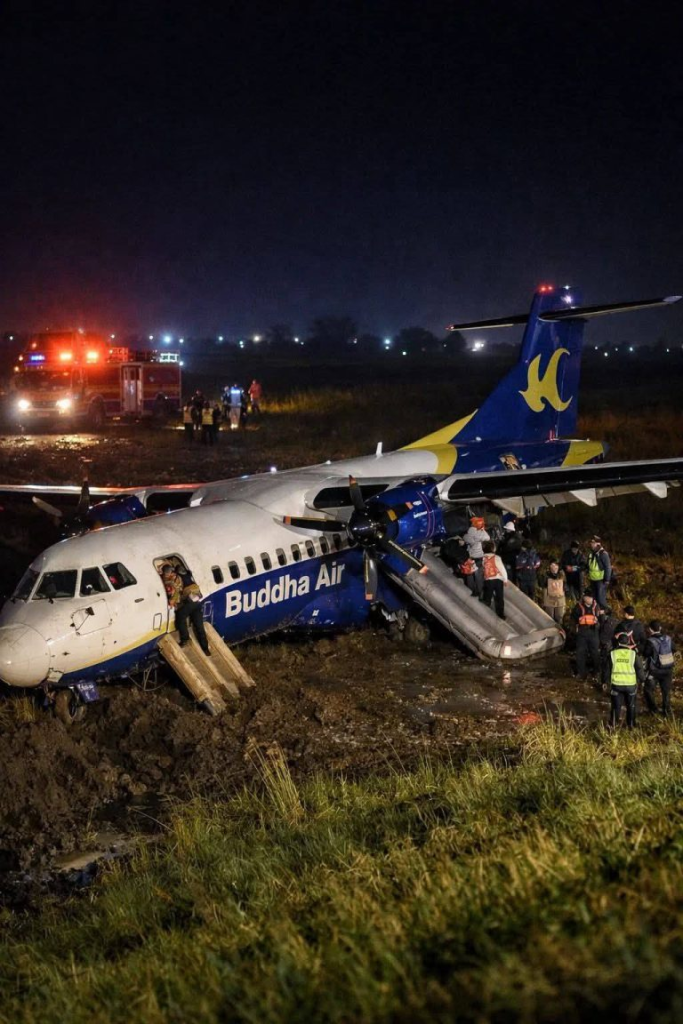
A passenger aircraft operated by Buddha Air suffered a dramatic runway excursion in eastern Nepal, triggering an international-standard safety investigation that has already uncovered serious structural damage, cockpit evidence under forensic review, and operational factors now under scrutiny across the aviation industry.
The ATR-72-500 aircraft, registration 9N-AMF, over shoot the runway at Chandragadhi Airport in Jhapa on January 2, 2026, carrying 56 people on board. While all passengers survived during the incident, investigators warn it could have turned catastrophic, and the unfolding probe is being witnessed by global aviation safety bodies.
The Ministry of Culture, Tourism and Civil Aviation has released the preliminary investigation report into the aircraft accident involving Buddha Air in Bhadrapur, Jhapa, but the official cause of the incident has not been made public.
The preliminary report, released on Sunday by the Ministry of Culture, Tourism and Civil Aviation, states that the definitive cause will only be announced in the final report after detailed technical analysis and examination of all available evidence.
The government had formed a prove committee led by senior Captain Binod Puri. The current report focuses primarily on the sequence of events rather than assigning responsibility or identifying probable causes.
Investigators have obtained the cockpit voice recorder, flight data recorder, and air traffic control recordings, and analysis of these materials is ongoing. Statements from crew interviews, eyewitness accounts, operational documents, and technical data are also under review.
Previously, it had been common practice for Nepal’s aviation investigations to mention possible causes even in preliminary reports. In this case, however, authorities have opted to withhold any such assessment until the final conclusion is reached.
The accident occurred on 18 Poush 2082 (January 2, 2026) when the ATR-72-500 aircraft (registration 9N-AMF) departed Kathmandu for Chandragadhi Airport in Bhadrapur. Upon landing, the aircraft skidded off the runway and was involved in an accident.
There were 56 passengers on board along with crew members. The aircraft was scheduled for a night stop in Bhadrapur. According to the preliminary report, the aircraft sustained serious structural and mechanical damage. Significant damage was found in the main and nose landing gear, propellers, and engines.
All passengers and crew were safely evacuated from the aircraft. Five passengers suffered minor injuries, including one crew member.
The report indicates that the aircraft skidded beyond the runway threshold and came to a stop approximately 183 meters outside it. Tire skid marks were visible starting from about 1,112 meters along the runway, suggesting that braking action had been applied by the crew in an attempt to stop the aircraft.
The aircraft had landed from Runway One Zero and appears to have touched down about 420 meters from the runway’s beginning. The accident also caused damage to the airport’s internal perimeter fence.
At the time of landing, the first officer was the pilot flying, while the captain was performing the pilot monitoring role. The captain is described in the report as an experienced pilot with a total of 7,133 flight hours. The co-pilot had got 498 flight hours experience. The flight was also the fifth and final sector of the day for the crew.
The final investigation report, once completed, is expected to determine the official cause of the accident and may include operational, technical, environmental, or human-factor findings.
A Routine Flight That Turned Dangerous
Flight BHA-901 departed Tribhuvan International Airport in Kathmandu at 14:36 local time, operating a scheduled commercial service to Chandragadhi. The aircraft was planned for a night stop at the destination.
The approach appeared normal at first. Air traffic control cleared the aircraft to land on Runway 10 at 15:16, after the crew reported their position at 4,400 feet near the MAHES waypoint.
Four minutes later, at 15:20, the aircraft touched down. That is when things started going wrong.
Flight data recorder information shows the aircraft touched down approximately 420 meters from the runway threshold — a key detail now central to the investigation.
Soon after landing, the aircraft began to skid. Tire marks later found on the runway indicate braking action began around 1,112 meters down the strip, suggesting the crew attempted to slow the aircraft after realizing something was not right.
Instead of stabilizing, the aircraft veered to the right, then to the left, before leaving the runway entirely. It smashed through the airport’s inner perimeter fence and finally came to rest 183 meters beyond the runway, damaged but still intact.